Maryland basements are a humidity problem
If your house is in Olney, Potomac, Bethesda, Rockville, Damascus, Silver Spring, or anywhere else in Montgomery County, your basement spends roughly four months a year fighting humidity. Summer dew points in the county run 65°F to 72°F from mid-June through early September (NOAA, Bethesda climate station). Warm air from upstairs hits the cooler basement walls and slab, water condenses, and the materials sitting on that slab get tested.
Some flooring materials shrug it off. Others rot. The list of what works in Maryland basements is shorter than the list of what doesn't, and the gap between a basement floor that lasts 25 years and one that warps in year 3 is mostly about picking the right material and installing it correctly.
This is the basement-flooring framework we use on every in-home measure across Montgomery County, regardless of which showroom you came in through.
What we install in basements, ranked
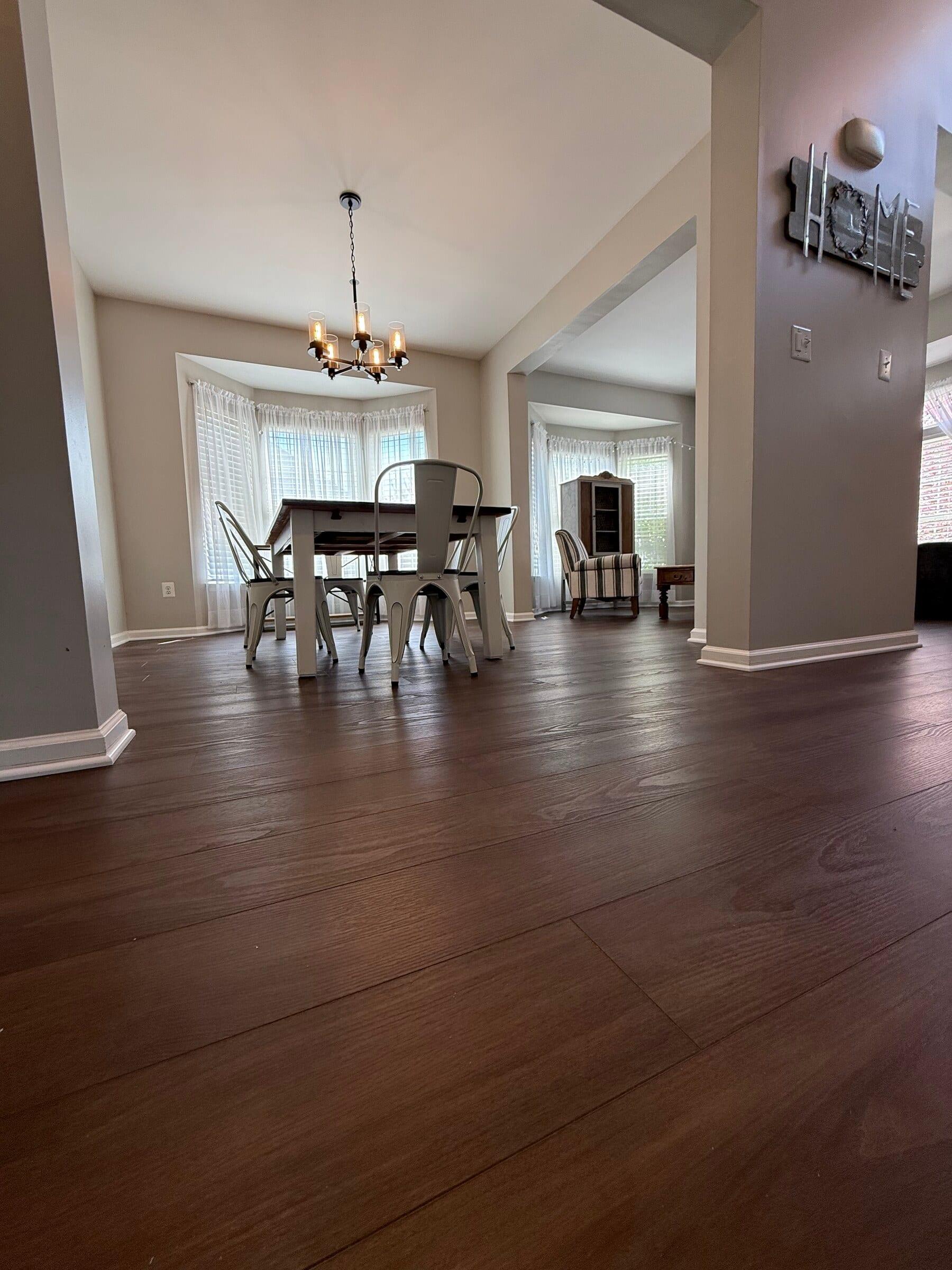
1. Luxury vinyl plank (LVP), waterproof core, 20-mil wear layer. The default recommendation for the majority of the basement jobs we do. Dimensionally stable across the humidity range a Maryland basement experiences (40% to 70% RH), accepts a moderate amount of standing water without permanent damage, and looks closer to real hardwood than any synthetic option in the same price range. Wear layer matters: the 20-mil minimum we install is the spec the existing carpetandvac.com luxury vinyl page calls out by name. We do not install 6-mil or 8-mil residential LVP in basements, regardless of what the price difference looks like on paper.
2. Sheet vinyl (commercial-grade). A close second for budget-sensitive jobs or basements with finishing constraints (low ceilings, structural pillars, unusual room shapes). Fully waterproof and seamless. Less hardwood-like aesthetic than LVP.
3. Ceramic or porcelain tile. Most water-tolerant option but the coldest underfoot and the most install-intensive. Right for laundry rooms, mudrooms, or basements that double as a kid's play area with regular spills. Requires a flat slab with proper crack-isolation membrane.
4. Engineered hardwood with full moisture barrier. Possible in a Maryland basement only if the slab tests below 4 lb / 1000 sqft / 24hr moisture vapor emission rate, you install a separate 6-mil vapor barrier under the underlayment, and you accept that a washer overflow or sump pump failure will damage the wood permanently. We do these only when the homeowner specifically wants real wood and understands the risk.
5. Carpet. Almost never. The mold and mildew risk at Maryland basement humidity levels is too high to justify in any room with regular exterior wall exposure. The narrow exceptions are theater rooms with reliable dehumidification and ground-level walk-out basements with full waterproofing on the perimeter. The customer phone calls we've taken from people who installed basement carpet against our advice are not phone calls we want anyone else taking.
6. Laminate. Never. The HDF core swells on moisture exposure and the damage isn't repairable.
Why wear-layer thickness is the single most important spec
The wear layer is the clear protective top coat on LVP. It's the variable that determines how long the floor lasts. Most online retailers and some big-box stores label any LVP "luxury vinyl" without distinguishing wear-layer thickness, and 6-mil to 8-mil residential product gets sold for basement use where it doesn't belong.
What we actually install:
- 20-mil for residential basements. Family room, finished basement, kids' play area.
- 22-mil for heavy-use basements. Home gym, basement workshop, basement that hosts guests regularly.
- 12-mil for upper-floor residential. Kitchen or bedroom where foot traffic and moisture exposure are gentler.
The price difference between 6-mil and 20-mil LVP is roughly 35% to 60% on a typical basement job. The lifespan difference is closer to 4x. With proper installation, 20-mil and 22-mil LVP in a Maryland basement should give you 20 to 25 years of useful life. 6-mil in the same basement starts showing wear in year 2 to 4.
Installation steps that determine whether the floor lasts
A waterproof LVP product is only as good as the installation. The places we see other contractors' basement installs fail across Montgomery County:
Slab moisture testing skipped or done badly. Every basement slab gets a calcium chloride test or an in-situ relative humidity test before LVP installation. If the slab is wet (above 4 lb MVER or 75% RH at the slab surface), installation pauses until the slab dries or a topical moisture mitigation system is installed. We don't install over a wet slab. We've watched too many other crews' jobs fail at year 2 because someone took the homeowner's word that the basement is dry.
Vapor barrier missing. Most LVP products include a thin attached pad that's fine for upper floors and inadequate for a Maryland basement. We add a separate 6-mil polyethylene vapor barrier over the slab before underlayment.
No perimeter expansion gap. LVP expands and contracts with temperature. A basement that runs 60°F in winter and 75°F in summer can move planks meaningfully across an 800 sqft room. Without a 1/4" gap at every wall and doorway, the floor buckles.
Click-lock joints not seated. Every joint gets tapped flush with a tapping block, not assumed flat. A joint that isn't fully engaged eventually pops and creates a seam where moisture can wick into the underlayment.
Slab not flat. LVP requires a substrate flat to within 3/16" over a 10-foot radius per most manufacturer install guides. Most Maryland basement slabs need at least some self-leveling compound to hit that spec. Skipping that step is the most common cause of LVP that crackles or feels soft underfoot a year after installation.
Related service
Luxury vinyl plank and laminate
See the service pageMore reads
- Luxury Vinyl
Luxury Vinyl Plank in Gaithersburg: Why It's Outpacing Hardwood on New Installs
4 min read - Laminate Flooring
Laminate Flooring in Damascus and Clarksburg: When It's the Right Call Over Hardwood or LVP
4 min read - Flooring Planning
Replacing Flooring One Room at a Time in Germantown: How to Plan the Connections
7 min read - Hardwood Installation
Hardwood Flooring in Olney, MD: Solid Above Grade, Engineered in the Basement
5 min read