The short answer first
If a room sees water or heavy paws, or the budget is tight, luxury vinyl plank usually wins. If you care most about resale and a floor that lasts for decades, hardwood wins. And if you want real wood in a basement or over a concrete slab, engineered hardwood is the compromise that makes both possible. Everything below is the detail behind those three sentences.
We install all three across Montgomery County, and we have no reason to push one over another. The right answer depends on the room, not on the trend.
What LVP, solid hardwood, and engineered hardwood actually are
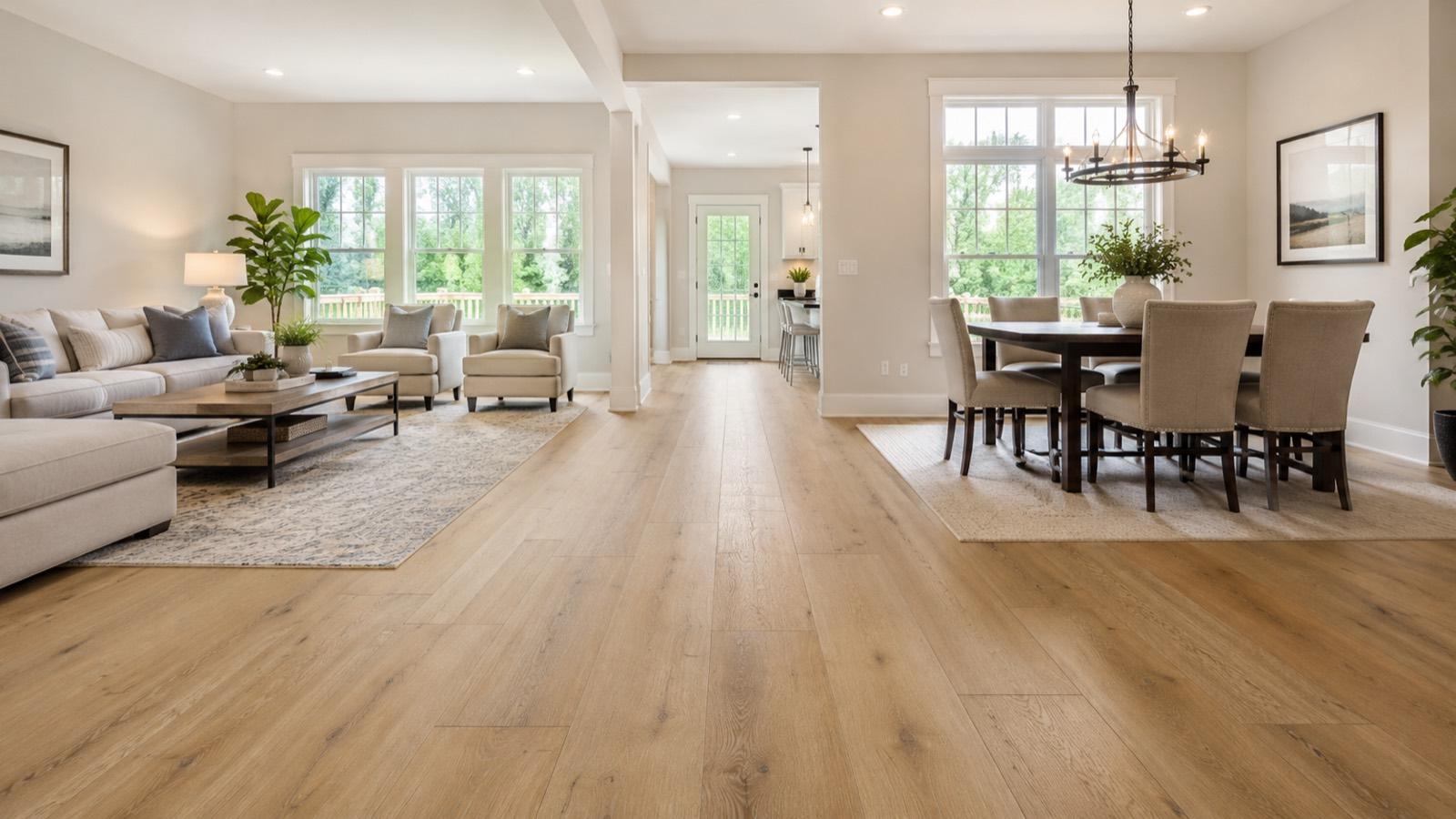
- Luxury vinyl plank (LVP) is a rigid vinyl core with a photo-realistic wood image and a clear protective wear layer on top. The whole plank is waterproof.
- Solid hardwood is a single piece of real wood, about three-quarters of an inch thick, that can be sanded and refinished many times.
- Engineered hardwood is a real-wood veneer bonded over a cross-layered plywood core. The top is genuine wood, but the core makes it far more stable than solid wood when humidity swings.
That last distinction matters more than most people realize, and it is the reason engineered wood can go places solid wood cannot.
The numbers at a glance
| Factor | LVP | Solid hardwood | Engineered hardwood |
|---|---|---|---|
| Installed cost (2026) | $4 to $16 / sq ft | $11 to $25 / sq ft | $9 to $20 / sq ft |
| Lifespan | 20 to 30 years | Decades to 100+ | Up to about 50 years |
| Water resistance | Waterproof core | Poor, damage is permanent | Good, not fully waterproof |
| Refinishable | No, replace planks | Yes, 4 to 10 times | Limited, 1 to 3 times |
| Pets and kids | Excellent | Scratches, but sands out | Scratches, fewer sandings |
| Resale impact | Neutral | Strongest | Strong |
The headline: LVP runs roughly one-third to one-half the installed cost of solid hardwood. For the exact line items in our area, see what flooring costs in Montgomery County in 2026. Cost ranges above track HomeGuide's 2026 figures for hardwood, LVP, and engineered wood.
Water, humidity, and Maryland basements
This is where the choice often gets made for you. LVP is waterproof to the core, so it belongs in kitchens, baths, laundry rooms, mudrooms, and basements. Solid hardwood is the opposite: standing water and below-grade moisture make it cup, swell, and eventually rot, and that damage does not sand out. Engineered hardwood sits in between, stable enough for a dry slab or a basement that stays dry, though its plywood core is still not something you want underwater. For what survives below grade in our climate, see our Montgomery County basement guide.
Refinishing and the real lifespan math
Here is the part that flips the cost story. LVP cannot be sanded or refinished; when it wears or gouges, you replace the damaged planks. Solid hardwood can be sanded four to ten times, which is how a wood floor lasts fifty or a hundred years and looks new again each time. Engineered hardwood can usually take one to three sandings, depending on how thick its veneer is. So while hardwood costs more up front, the ability to renew it instead of replacing it is exactly why it can be the cheaper floor measured across decades. If your existing wood is dull but sound, refinishing is almost always the better buy than tearing it out.
LVP vs. engineered hardwood, head to head
This is the comparison most people are really weighing, because both can go in a basement and both look like wood. Engineered hardwood gives you a genuine wood surface, the warmth and resale pull of real wood, and the option to refinish once or twice. LVP gives you a fully waterproof floor, a tougher everyday surface against pet nails and dropped toys, and a noticeably lower price.
On resale, wood still moves the needle most: the National Association of REALTORS has reported new wood flooring returning around 118 percent of cost and refinishing existing hardwood recovering close to 147 percent, while quality LVP stays roughly neutral. For dogs specifically, LVP is the standout: waterproof, with a wear layer that resists the scratching dog nails inflict on wood. So if the room is dry and you want real wood, choose engineered. If the room sees water, kids, or dogs, or the budget is the deciding factor, choose LVP.
Which floor for which room
- Kitchens, baths, laundry, mudrooms, basements: LVP.
- Bedrooms, living and dining rooms, main living areas above grade: solid hardwood.
- Real wood below grade or over concrete: engineered hardwood.
- Homes with dogs or young kids: LVP in the busy zones, hardwood where it stays dry if you want the wood.
Questions to ask before you choose
- Is this room below grade, over a slab, or anywhere it can get wet?
- Do you have dogs or young kids?
- Do you plan to sell within about five years?
- What wear-layer thickness is quoted, in mils? (Insist on 20 or more.)
- For real wood, is solid or engineered right for this subfloor?
- Could refinishing the floor you already have beat replacing it?
- What is the all-in installed cost, with subfloor prep included?
The honest recommendation
There is no universally best floor, only the best floor for a given room and a given household. Bring your room dimensions, a photo of the subfloor, and your budget into the Olney or Potomac showroom, and we will walk all three options with you and tell you where each one makes sense. We measure and install across Olney, Potomac, Rockville, Bethesda, and the wider Montgomery County area, and most homes end up with more than one of these floors, each in the room where it belongs.
Related service
Flooring installation across Olney, Potomac, and Montgomery County
See the service pageMore reads
- Hardwood Flooring
Is Engineered Hardwood Real Wood? What the Layers Actually Mean
6 min read - Flooring Costs
What Flooring Costs in Montgomery County in 2026: Per-Square-Foot Ranges by Material
7 min read - Choosing Carpet
How to Choose Carpet: Fiber, Style, and Where Each One Belongs
7 min read - Luxury Vinyl
Luxury Vinyl Plank in Gaithersburg: Why It's Outpacing Hardwood on New Installs
4 min read