The short answer: yes, engineered hardwood is real wood
Engineered hardwood has genuine wood on the surface you see and walk on. What makes it "engineered" is the structure below that surface: several layers are arranged to improve stability instead of using one solid piece of lumber from top to bottom.
That simple answer needs one important qualification. Engineered products do not all have the same core, wear-layer thickness, finish, or refinishing potential. If you are comparing samples, the useful question is not only, "Is this real wood?" It is, "How is this particular wood floor built?"
Solid, engineered, and composite-engineered wood
The National Wood Flooring Association's real-wood definition separates wood flooring into three useful groups:
- Solid wood flooring is one piece of wood from top to bottom.
- Engineered wood flooring uses multiple wood veneers or slats, normally arranged in opposing directions, with real wood as the wearable surface.
- Composite-engineered wood flooring has a real-wood wearable surface over a wood-based composite core or backing.
Retail labels are not always this precise. A store or manufacturer may use "engineered hardwood" for products with plywood, wood-slat, high-density fiberboard, or medium-density fiberboard cores. That does not make the surface fake. It means the specification sheet matters.
Engineered hardwood vs. solid wood, laminate, and LVP
| Flooring | Surface you walk on | Core | Can it be refinished? | Moisture note |
|---|---|---|---|---|
| Engineered hardwood | Genuine wood | Wood veneers, slats, or wood-based composite | Sometimes, depending on the product | More dimensionally stable than solid wood, but not waterproof |
| Solid hardwood | Genuine wood | The same piece of wood throughout | Usually, subject to condition and remaining thickness | Seasonal movement must be managed |
| Laminate | Printed decorative layer under a clear wear layer | Fiberboard | No | Seams and core can swell if water gets in |
| Luxury vinyl plank | Printed design under a vinyl wear layer | Vinyl or rigid composite | No | Product water-resistance claims vary |
The distinction matters because each category behaves differently. A homeowner who wants the look, grain, and aging characteristics of wood may prefer engineered or solid hardwood. Someone prioritizing a printed visual, dent resistance, or a different moisture profile may also compare LVP with hardwood.
What the wear layer tells you
The wear layer is the genuine wood above the core. Its species and cut create the visible grain. Its thickness helps determine whether sanding may be possible later.
There is no safe category-wide promise that every engineered floor can be refinished. The NWFA's voluntary Certified Refinishable program sets minimum wear layers of 2.5 millimeters for factory-finished products and 3.2 millimeters for unfinished products, along with installation and manufacturer requirements. That certification is a useful benchmark, not proof that every product outside the program can or cannot be refinished.
Before buying, ask for:
- The wear-layer thickness in millimeters.
- Whether the manufacturer permits sanding or only a lighter maintenance coat.
- Whether texture, bevels, or distressing change the refinishing options.
- Which installation methods preserve the warranty.
- The written care and humidity requirements.
If long-term repairability is central to your decision, compare the actual specifications rather than assuming that a thicker overall plank means a thicker wearable surface.
Why the layers can help in Maryland homes
Wood responds to moisture. In Montgomery County, humid summers and dry, heated winters can create seasonal expansion and contraction. Engineered construction is designed to reduce that movement by arranging layers in different directions.
Reduced movement does not mean no movement. The room, subfloor, HVAC, moisture level, plank width, species, and installation method still matter. The NWFA homeowner handbook notes that engineered wood can be suitable on any level of a home, including some below-grade applications, but the exact product instructions remain the authority.
This is why an engineered floor may be considered for:
- A finished basement where the selected product is approved for below-grade use.
- A room over a concrete slab after appropriate moisture evaluation.
- A wide-plank look where dimensional movement is a concern.
- A radiant-heat assembly when the flooring and heating manufacturers both approve the combination.
None of those settings makes every engineered product interchangeable. One manufacturer may approve a plank for glue-down installation over concrete while another may not. Product approval, subfloor preparation, and moisture control have to agree.
Five myths worth clearing up
Myth 1: engineered hardwood is fake wood
The wearable surface is genuine wood. The layered construction is different from a solid board, not a substitute photograph.
Myth 2: all engineered hardwood is plywood underneath
Many products use plywood-style veneers, but others use wood slats or wood-based composite cores. Read the construction details.
Myth 3: engineered hardwood is waterproof
It is still wood flooring. Clean spills promptly, address leaks, and follow the maker's humidity and maintenance instructions. Our floor-care guide explains the routine that protects both solid and engineered wood.
Myth 4: every engineered floor can be refinished
Refinishing depends on the wear layer, surface, installation, condition, and manufacturer. Get the answer in writing for the exact collection.
Myth 5: more stable means installation conditions do not matter
Engineered construction helps manage movement. It does not replace acclimation when required, moisture testing, a sound subfloor, or the approved adhesive or fastening method. Our hardwood installation guide explains why those steps affect the finished floor.
A practical showroom checklist
When two samples look similar, compare them with these questions:
- Is the surface species the wood I want, and how will its grade and cut affect the grain?
- What is beneath the surface?
- How thick is the wear layer?
- Is the product approved for my level of the home and my subfloor?
- Which installation methods are approved?
- Can it be recoated or sanded later?
- What indoor humidity range and cleaning products does the warranty require?
- What is covered, for how long, and what documentation must I keep?
The right answer may be solid hardwood, engineered hardwood, or another material. The point is to match the construction to the room instead of treating "engineered" as one uniform product.
Compare the layers in person
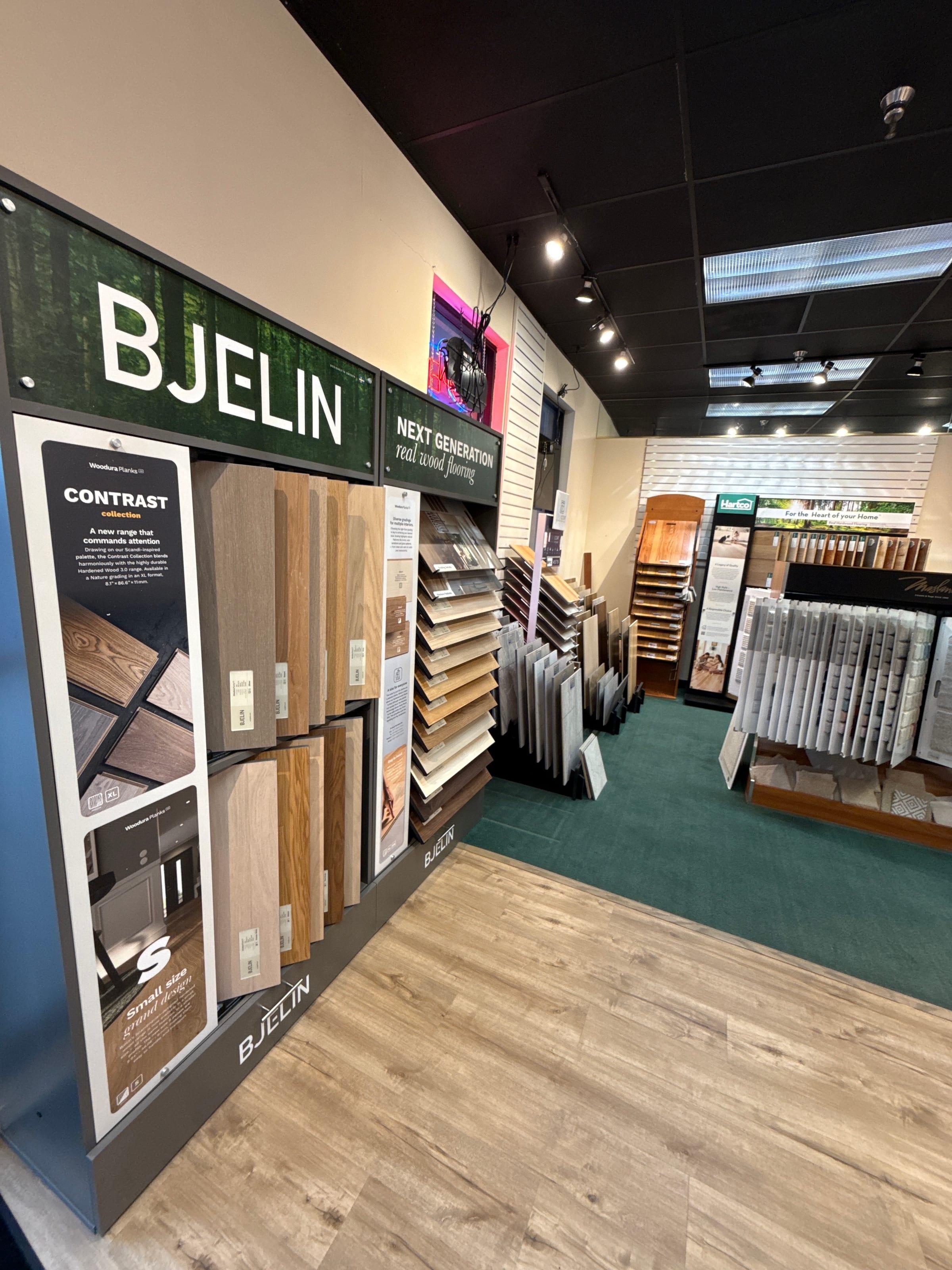
An edge view and a specification sheet answer questions that a room photo cannot. Bring your room details, subfloor information, and the look you want to either our Olney showroom or Potomac showroom. We can put solid and engineered samples side by side, explain what is known about each construction, and help you narrow the options for homes across Montgomery County.
Related service
Hardwood flooring across Olney, Potomac, and Montgomery County
See the service pageMore reads
- Flooring Comparison
LVP vs. Hardwood: How to Choose for a Montgomery County Home
6 min read - Choosing Carpet
How to Choose Carpet: Fiber, Style, and Where Each One Belongs
7 min read - Hardwood Flooring
Hardwood Flooring in Rockville: Solid, Engineered, or Refinish What's Already There
4 min read - Flooring Costs
What Flooring Costs in Montgomery County in 2026: Per-Square-Foot Ranges by Material
7 min read